
Bahama Shutters: Style, Storm Protection, and Cost
Some shutters only come out for a storm. Bahama shutters earn their place the rest of the year, too.
A Bahama shutter is a louvered panel hinged at the top of a window. In normal weather it is propped open at an angle on support arms, like a small awning over the glass. When bad weather comes, the arms come off or fold away, the panel drops flat over the window, and it latches closed.
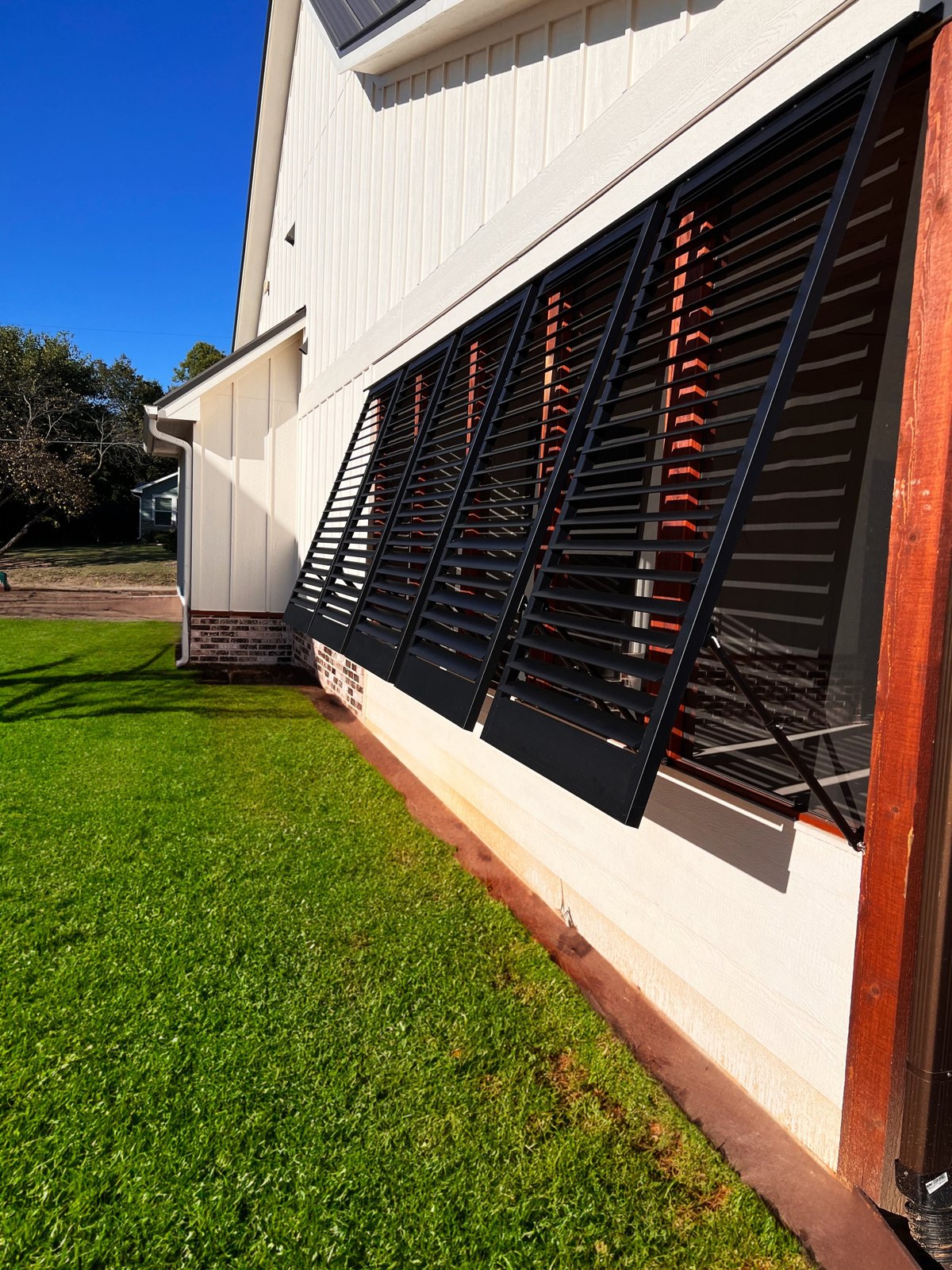
Bahama shutters propped open on their support arms — everyday shade and airflow in this position, full window coverage when the panels drop and latch.
That one design explains all three reasons people buy them: the look, the everyday shade, and — in the right version — storm protection.
The style part is real
Exterior Bahama shutters change the face of a house. The angled louvers give a coastal, tropical look that suits Gulf Coast, Florida, Caribbean-style, and low-country homes, and they read as part of the architecture rather than as equipment bolted on for storm season.
Because they are visible every day, the choices that matter are louver style, frame style, color and finish, and how far the panel props open. Get the installer to show you finished photos on homes like yours before you pick.
What they do on an ordinary day
Propped open, a Bahama shutter shades the window from high sun while the angled louvers still let in light and air. That is the practical payoff:
- Less heat and glare on sun-facing windows, because the sun is stopped outside the glass instead of inside the room.
- Privacy from the street and from neighbors above, without closing the room up.
- Rain cover over the window in a light rain, so windows can often stay open for breeze.
- A view that stays — you look out under the panel, rather than through a closed shutter.
On a west- or south-facing window that bakes in the afternoon, that everyday shade is often the main reason for buying them. Storm protection, when it is there, is the bonus.
Storm protection: rated vs. decorative — the key split
This is where Bahama shutters are most often misunderstood. Not every Bahama shutter is a hurricane shutter.
- Decorative Bahama shutters are built for look and shade. They may be lighter, they are not tested as storm protection, and you should not count on them in a hurricane — no matter how sturdy they feel.
- Hurricane-rated Bahama shutters are engineered and tested for impact-rated protection. Hurricane shutters used for impact protection typically must carry the kind of certification local storm codes require, and the rating has to cover a window the size of yours.
The panel may look almost identical from the street. The difference is in the materials, the frame, the hinges and latches, and the paperwork.
Before you buy any Bahama shutter as storm protection, ask the installer, in writing: Is this exact shutter rated and approved for hurricane protection here, and can I see that paperwork? If the answer is vague, treat what you are buying as shade and style — which may still be worth buying, just not under a storm promise.
Closing a rated set for a storm is hands-on work: go to each window, release or remove the support arms, lower the panel, and latch it. On a one-story home that is simple. On second-story windows, plan for a ladder and extra time, and do a practice run before storm season, not during the first watch.
What drives the cost
Bahama shutters are priced per window, and there is no honest single number that fits every house. What moves a quote is:
- Rated or decorative. A tested, impact-rated build costs more than a decorative panel — you are paying for engineering, heavier materials, and certification.
- Size of the window. Bigger windows need bigger, stronger panels, hinges, and arms.
- Material and finish. Heavier-duty metal builds and custom colors or finishes cost more than basic options.
- How many windows, and where they are. A whole-house job spreads the install visit across more panels; second-story and hard-to-reach windows add labor.
- Mounting surface and condition. Brick, stucco, wood, and siding mount differently, and repairs to damaged trim or framing are not part of a standard quote.
Compare quotes on the same windows, with the same rating — or the same clear statement that there is no rating. A low quote for a decorative panel and a higher quote for a rated one are not two prices for the same thing.
Checks before you order
- HOA and local rules. Because Bahama shutters change how the house looks, some communities want approval, a photo, or a specific color first.
- Clearance. The panel props out from the wall and drops flat. Check walkways, landscaping, and anything mounted under the window.
- Which windows actually need them. Many owners do the sun-blasted and storm-exposed windows first, and leave shaded or sheltered windows for later.
The short version
Buy Bahama shutters for shade and style, and you will use them every sunny day. Buy them for storm protection too, and make sure the rated version — with paperwork for your window sizes — is what is actually on the quote. Confusing those two buys is the one mistake to avoid.
Get matched with a local installer — free
Exterior Shade Guru doesn't sell shutters and doesn't push any brand. Tell us about your home and we'll match you with a local installer — no cost, no obligation.
→ Homeowners & restaurants: Request a free match → Installers: Get free leads